

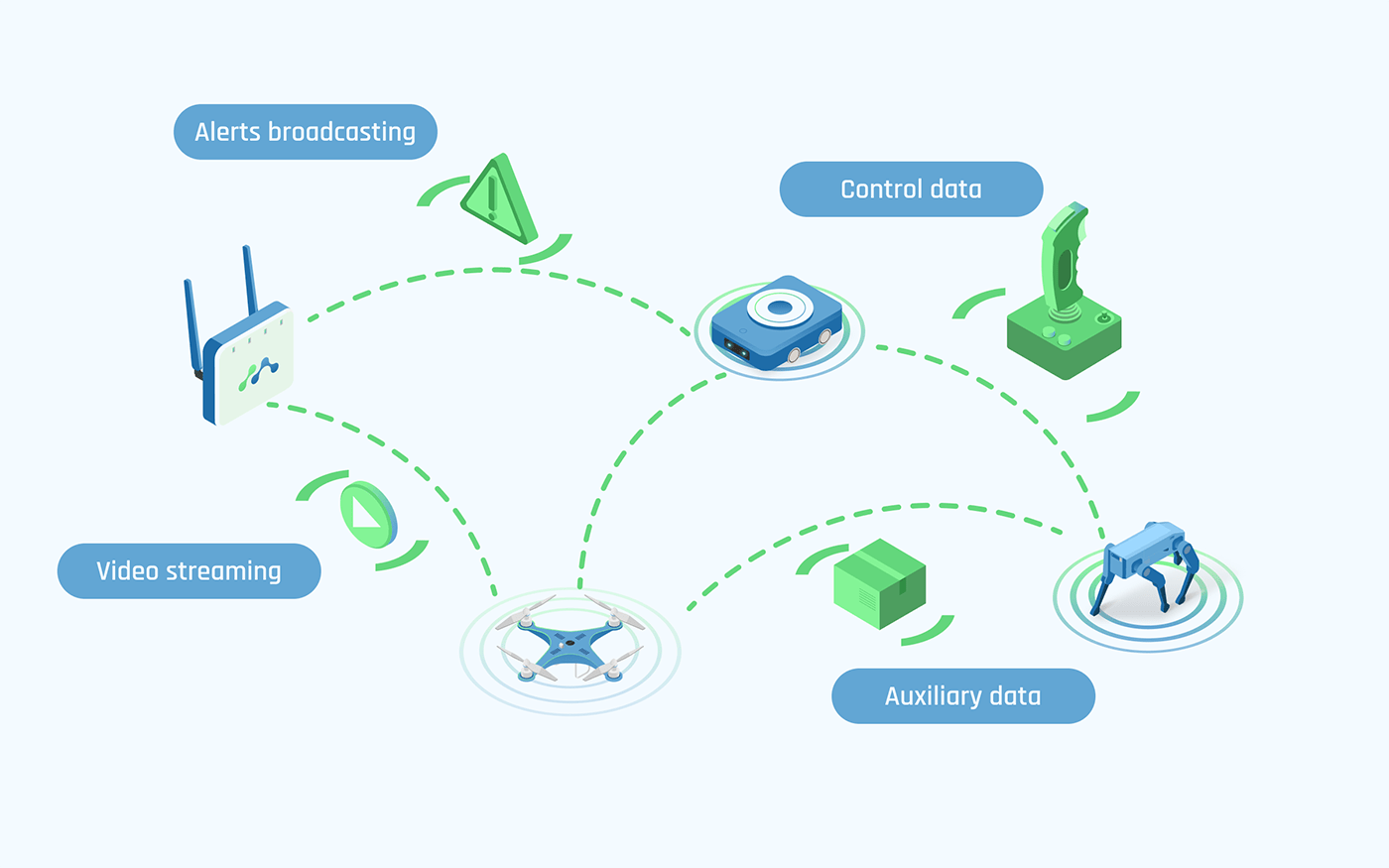
In the era of Industry 4.0, the fusion of cutting-edge technologies is revolutionizing the industrial landscape. Robotics, AI, and other technologies are not just evolving – they are making giant leaps forward. However, the success of these advanced technologies hinges not only on their capabilities but also on the robustness and adaptability of the networks that connect them. Complexity and scale of industrial applications constantly grows. Traditional networking solutions often fall short of meeting the dynamic demands of these systems. Recognizing this critical gap, Meshmerize developed a groundbreaking mesh networking software designed to complement the rapid advancements in robotics and other Industry 4.0 technologies. Our solution ensures seamless, reliable, and efficient communication, keeping pace with the fast-evolving landscape of Industry 4.0.
Join us as we explore some of the pivotal technical concepts Meshmerize employs to ensure uninterrupted operations and smooth data flow.
Mesh networking meeting Industry 4.0 traffic requirements
Machinery, robots, and other devices are becoming increasingly autonomous, mobile, and tasked with operating in challenging environments. They should perform with minimal human intervention and adapt seamlessly as the system scales. To meet these demands, the backbone of Industry 4.0 – its network – must ensure uninterrupted data flow. This also means high reliability and low latency, all while preventing congestion.
Meshmerize orchestrates this complex symphony with ease. Smart traffic management is at its core, dynamically prioritizing and routing data to maintain efficiency. By intelligently managing the traffic, the network can adapt in real-time to changing conditions and requirements, giving critical data the utmost priority. This adaptive approach minimizes the need for manual configuration.
Key features of advanced network traffic management
Although Meshmerize is a feature-rich software, this blog post will discuss the features that handle the data packets inside the mesh, including multipath routing, traffic prioritization, and optimized broadcasting. For example, Meshmerize fast-tracks critical information, unlike traditional networks. Optimized broadcasting reaches all nodes without congestion, while multipath routing further bolsters reliability.

Understanding airtime
The concept of airtime is essential to grasp how traffic navigates through a network. Think of airtime as the speaking time for devices within the network, similar to taking turns in a group conversation. Just as only one person can talk at a time without confusion, devices must take turns to communicate to avoid data collisions and ensure clarity in a network.
However, this orchestration is not just about order – it is fundamentally about efficiency. As the network scales, introducing more devices, the traffic management is not just significant—it escalates dramatically. This amplifies the importance of minimizing, or better said, optimizing the number of transmissions. Efficient use of airtime is not merely about conserving speaking time. It is also about reducing the escalating overhead that comes with each additional packet, especially in more crowded networks. This nuanced approach to managing airtime is critical for preserving airtime. The system must remain robust and efficient, particularly as it grows.
Advanced multipath routing in Meshmerize mesh networking
Traditional networks follow a single path to send data. On the other hand, Meshmerize mesh networking software allows data to navigate multiple routes for the most reliable journey to its destination. What sets Meshmerize apart is its strategic approach to network changes, balancing risk diversification with network efficiency and avoiding network congestion even as data takes multiple paths.
Another perk here is the unique packet identification. With it, Meshmerize guarantees that all pieces of data, regardless of their route, come together accurately at the endpoint. For an in-depth exploration of the Meshmerize multipath routing and its impact on industrial connectivity, click here to read our detailed blog post.
Optimized broadcasting with Meshmerize
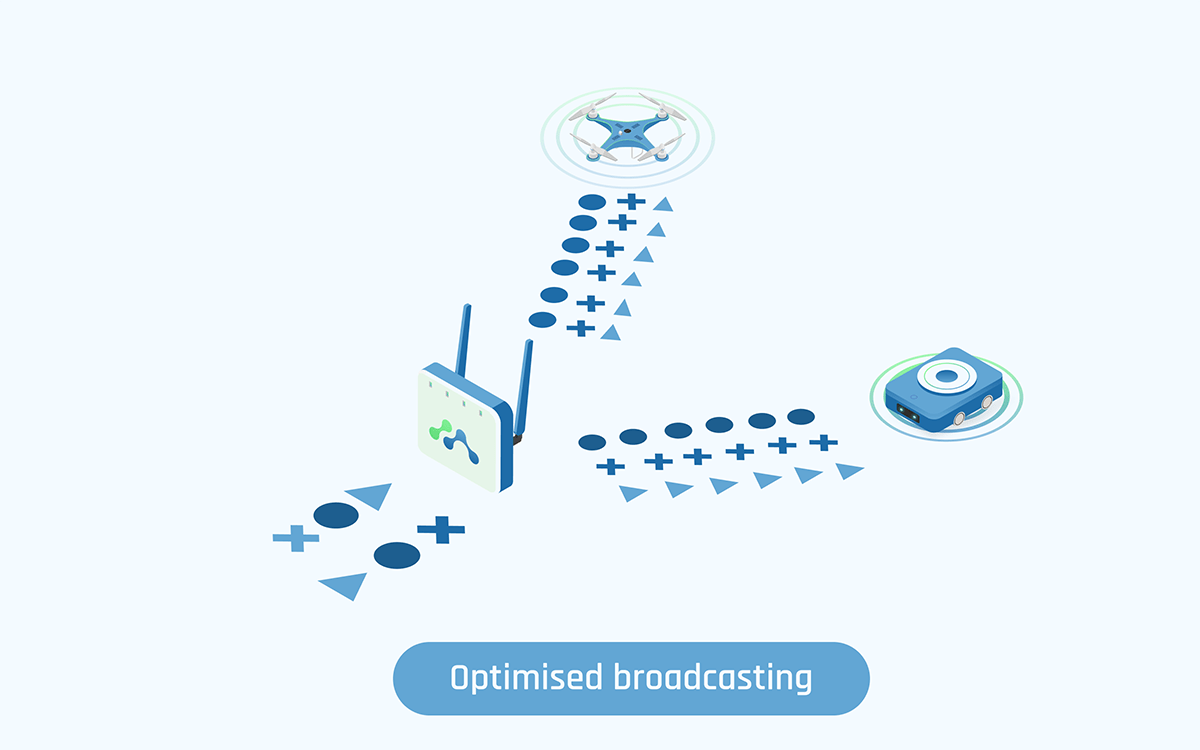
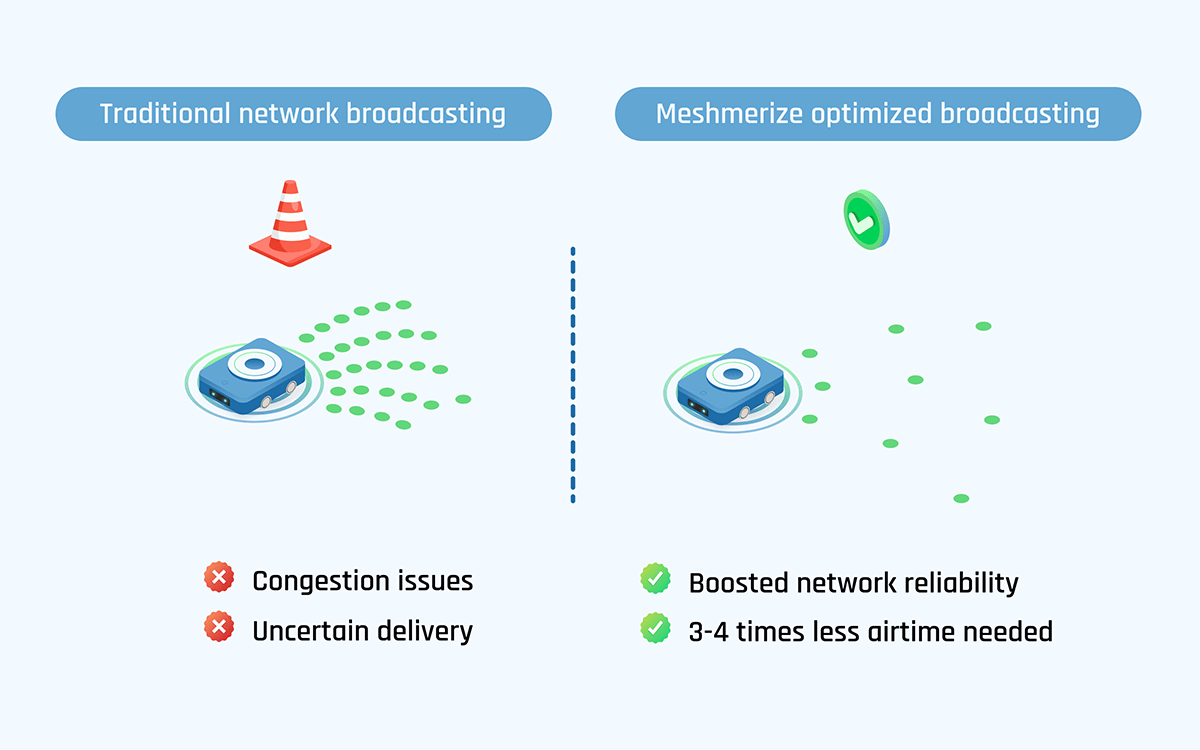
Broadcasting in mesh networking is a complex yet crucial task of sending messages to all nodes. It works like announcing a message to everyone in the room. However, this approach can quickly lead to congestion in a mesh network. In extreme cases, it can grind communication to a halt. Such a scenario is particularly problematic in mesh networking because redundancy is built-in for reliability.
The Meshmerize innovative approach shines here. Unlike other mesh protocols that can consume three to four times more airtime for broadcasting, leading to congestion or complete network halt, Meshmerize reduces this redundancy by recognizing the unnecessary data repetitions by employing advanced algorithms that identify and eliminate redundant transmissions. This works something like echos used by bats to communicate. It is like knowing when to stay quiet during a conversation because everyone has already heard what you have to say, preventing any added noise.
Meshmerize broadcasting strategy further refines this process. Nodes participating in the broadcast are aware of their surroundings, allowing them to remain quiet in busy parts of the network if all neighbors are sufficiently informed already. Conversely, if the message is not as widespread, the node actively broadcasts it but with a twist—directing it away from where it came from. This ensures the message spreads outward efficiently rather than circulating in the same area.
By smartly managing the dissemination of broadcast messages, Meshmerize ensures network harmony. This prevents the avalanche effect of redundant broadcasts and maintaining optimal network performance.
Mastering traffic prioritization in Meshmerize
Following the innovative optimized broadcasting, another critical aspect that sets Meshmerize apart is its ability to set different traffic prioritization levels. In the bustling network city, where data packets are like vehicles on the road, not all traffic can be treated equally. Just as emergency services have priority, some data requires expedited delivery to maintain the system integrity and efficiency. For instance, these are control messages. These ensure a device is moving in the right direction or instantly stopping if needed.
Meshmerize excels in this domain by implementing a sophisticated traffic prioritization system. This system categorizes data into different levels of urgency or priority. Vital commands and operational information take precedence over less critical data, such as routine status updates or video feeds. This hierarchy ensures that in times of high network demand, essential communications are not delayed by less significant data.
Hierarchy of traffic priorities in mesh networking
As an example, this could be a hierarchy of traffic priorities in a Meshmerize network:
- Control traffic: This is the highest level of priority, reserved for operational commands that direct the movements and actions of the device.
- Broadcast traffic: Broadcast messages have a mid-level priority, ensuring a balanced flow of control messages and collision avoidance mechanisms.
- Video traffic: Video feeds are assigned a lower priority. This ranking reflects the comparative importance of real-time operational commands over visual data in ensuring the immediate safety and coordination of the deployment.
- Auxiliary data: The lowest tier includes data like logs and non-essential updates. These data types are transmitted only when the network is less congested.
The Meshmerize prioritization is comparable to having a smart traffic control system that dynamically adjusts traffic lights based on the urgency of each vehicle. Through this, it ensures that the most critical data reliably reaches its destination first. This nuanced approach is especially crucial in Industry 4.0 environments, where timely data transmission can be pivotal to safety and operational efficiency.
By intelligently managing the data flow, Meshmerize ensures that the network remains resilient and responsive. Even under heavy loads, the network reinforces the reliability and robustness required for the demands of Industry 4.0.
Meshmerize in action: transforming industries with mesh networking
Meshmerize’s advanced features are transformative tools reshaping various industries, for example:
- Dynamic path adjustment by broadcasting positional data is pivotal for collision avoidance in AGVs, UAVs, and machinery in construction and agriculture.
- Separating lanes for command messages, image/video feeds, and sensor data through the network ensures smooth data flow.
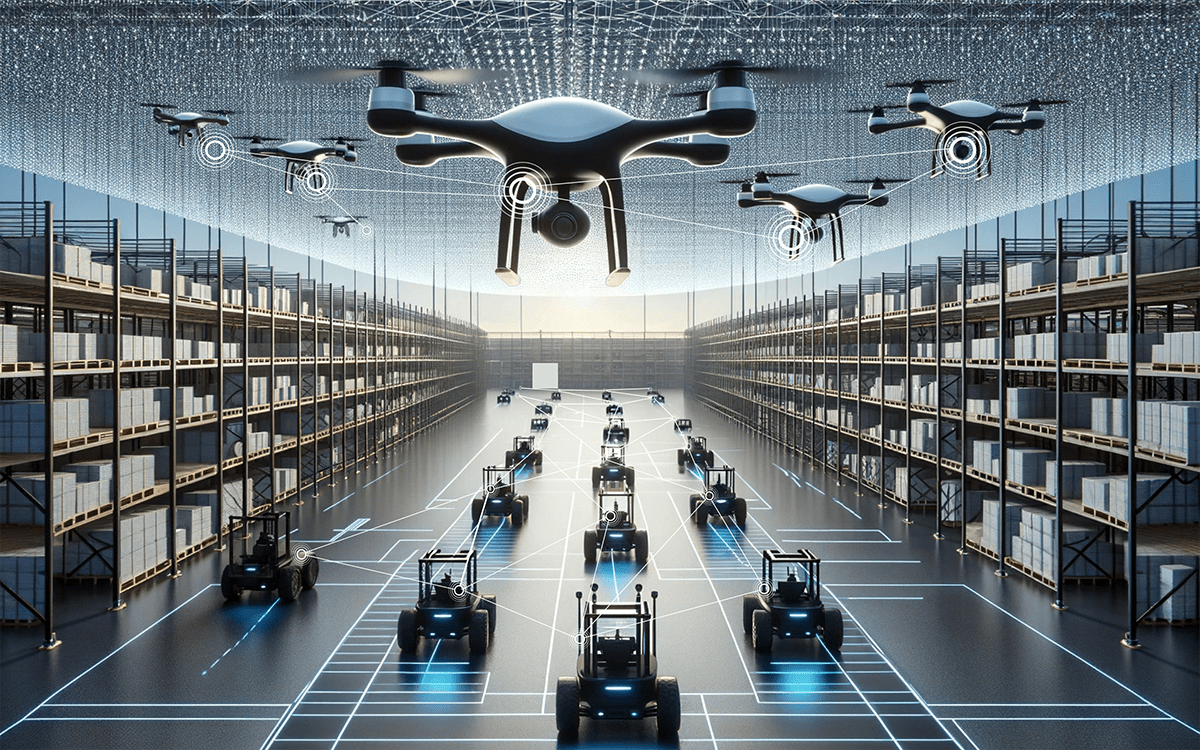
- Quick response to environmental changes mitigates risk in diverse settings like skies, fields, warehouses, and construction sites
Powering the pulse of Industry 4.0
Through its innovative features like optimized broadcasting, traffic prioritization, and multipath routing, Meshmerize addresses the critical need for robust and adaptable networks that are also intelligent and efficient.
By managing data flow, Meshmerize enables devices across various sectors—from agriculture and construction to UAVs and AGVs—to perform optimally, adapt to environmental changes swiftly, and communicate without interruption.
The demands of Industry 4.0 continue to evolve. Meshmerize is committed to staying at the forefront, providing a highly reliable mesh networking solution that ensures seamless connectivity. We’re dedicated to matching the pace of innovation, excited to fuel the growth and potential of Industry 4.0, enabling industries to achieve their full potential.
Meshmerize is a startup based in Dresden, Germany that provides the ultimate mesh networking software to an array of industries. The full potential of Meshmerize is yet to be seen. We would like to hear your thoughts – let us know what you think at hello@meshmerize.net
![Breaking boundaries in logistics: Powering some of the largest automated warehouses with Meshmerize and Movu Atlas shuttles [a technical deep dive]](https://meshmerize.net/wp-content/uploads/2023/05/warehouse-network.jpg)